
Where is Jesus? The tomb is not yet unsealed. Is he just hanging out playing cards with the angel messenger, waiting for his Father to give a mighty shove and roll away the stone? Not such a dumb question as you might think? For the Church in her infancy pondered over this question long into the first centuries . And then they struck on the answer in our Baptismal Creed.
You know the words of the Creed: “Suffered under Pontius Pilate, crucified, died, and was buried, he descended into hell (or to the dead as modern translators would have it)….”
“Crucified died and was buried, he descended into hell.” The First Epistle of Peter speaks of Christ’s descent into hell, called by the Church in the East the Anastasis, and by the Church in the West The Harrowing of Hell. So just what, in hell, is Jesus doing? This Harrowing of Hell. It’s from the English to harrow, to despoil, to break apart. Today, Satan’s territory is being broken.
After his death that Friday afternoon, when he breathed his last, Jesus descended to hell. Having harassed us, the living, he descended to the dead. He is there, preaching to them, enticing those who did not have the benefit of his life and words of grace during their lives.
It was inconceivable to the church that so many would be excluded from his love and grace. He is there today, now again, doing what he does so well: preaching, teaching, healing, seeking, inviting. He is there announcing the love, mercy, and forgiveness of God.
So just what, in hell, is Jesus doing?
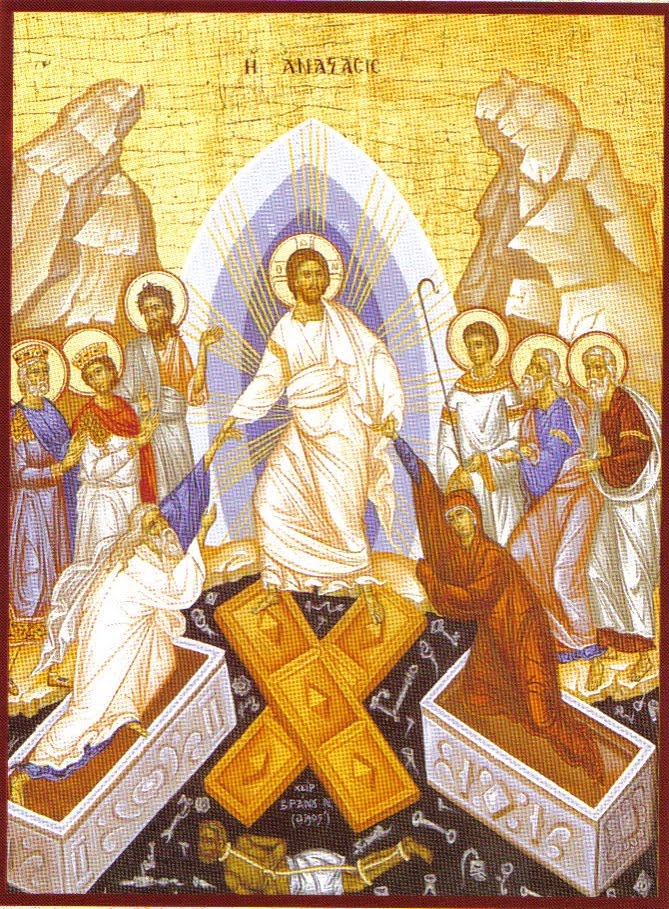 There is an icon showing Christ’s descent into Hell. The Icon of the Anastasis or the Harrowing of Hell depicts Christ, standing on Hell’s broken gates, pulling Adam and Eve out from their tombs. Groups of souls are being led out of Hell as angels beat down the demons. Crowds of Old Testament kings and biblical figures stand surrounding them. It is Christ, having been lifted up, now drawing all to himself.
And though he is down there, there is something to be said to those of us here. That word is this: Because he is there, tonight, descended into the deadly darkness, confronting the enemy on the enemy’s own turf, we have hope.
We cling to the cruciform promise that “God loves us, for Christ’s sake, and will never let us go.” The only God we can truly know, or dare to give our hearts to, is the one we see in the crucified Christ. There, in that brokenness, we find the God who gives anything and everything to be reconciled to us, who takes on every sin, every shame, every pain, every curse that befalls us or that we visit on one another. And in exchange, we take from that cross the crucified one’s identity – we are children, the sons and daughters of God. Nothing more; nothing less.
And the Harrowing of hell is more of God’s promise. If Jesus is there, then know well that nothing — no darkness, bereftness, or pain we experience, is immune from his gracious presence. If he, though he was God, is able to risk all, to wade deep into the death we so fear and avoid, then what might he risk for us?
Martin Luther says it best on what it means to confess that Jesus Christ descended to hell. “It means this,” said Luther, “that there is no place I might ever go, no depth to which I might sink, but that even there, Jesus is Lord for me.”
 On the Border of the Holy