I don’t get lost. Oh, I might get turned around for a bit. Sometimes I have to stop for a moment and think about where I am and where I want to be. Sometimes I even get that odd look from my wife as we travel down unusual roads to the usual places. But I’ve never really been lost. It took me some time when I was a child to understand that other people could get lost. My grandmother used to say I had a “bump of direction.”
For me, the US Army’s Land Navigation courses were fun; yes, there was serious work afoot, but it was still fun. Using map coordinates to determine where you are and where you want to go, plotting the route, checking your pace count, making the trek across country, and actually getting there can be challenging. But the maps we used were incredible: detailed in every way with streams and rivers right where they were supposed to be; distances so accurate that you could wind up within a few feet of your plotted destination after miles of hiking through dense woods. I learned how to determine heights and land features just from the curve of the map contour lines and match these to the actual physical terrain. You could put me down anywhere with a map and a co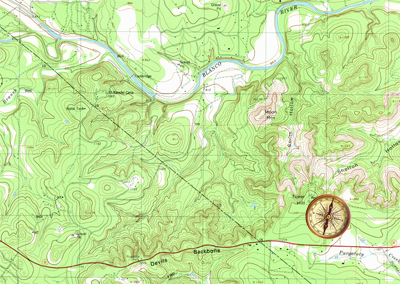 mpass. Tell me where I needed to be, and I would be there.
I also found out that there is a big difference between reading features on a map and experiencing them in real life. Those little brown contour lines really close together on a map noting an incline don’t begin to capture the exertion needed to climb a 95-foot vertical cliff-face. And that thin blue line cutting straight through your intended path that can’t be avoided, doesn’t begin to express the shock wading chest deep through a spring-fed stream – or the chill that continues as you try to dry out.
The way we interpret scripture, the claims we make for Jesus, and the theology we construct is like a map: it is a resource for our journey with God through life. And just like a map, it instructs us in the path our journey needs to take. It can point out the dangerous places and challenges along the way. But there is a difference here, too, between what we read on the map and experiences in our lives.
Love one another, says scripture. But how does one continue to do so when confronted by betrayal of trust, jealousy, or seeing another’s love grown cold. Wine gladdens the human heart, says scripture. But tying one on and the gray dawn of the morning after are nobody’s idea of a good time.
I contend it is the sacramental life of the community of faith that is the greatest hope and source we have of making meaning of our lives. Without making use of the means available in the sacramental life of the community, we are impoverished in understanding ourselves and creation. It is in the community gathered we affirm our life’s journey, study “the map” and support each other in sharing our experiences in the world. This is the place where we may find the paths through our life, and celebrate with the God who calls us forward in his name.
 On the Border of the Holy